
What to Look for in Multihead Weigher Manufacturers Before You Buy
Choosing among multihead weigher manufacturers is rarely about price alone. It comes down to whether the machine can hold its weight accuracy at speed, hour after hour, without babysitting from an operator. For buyers moving from manual scales or single-head fillers, the jump to a multihead system changes the math on labor, waste, and throughput all at once.
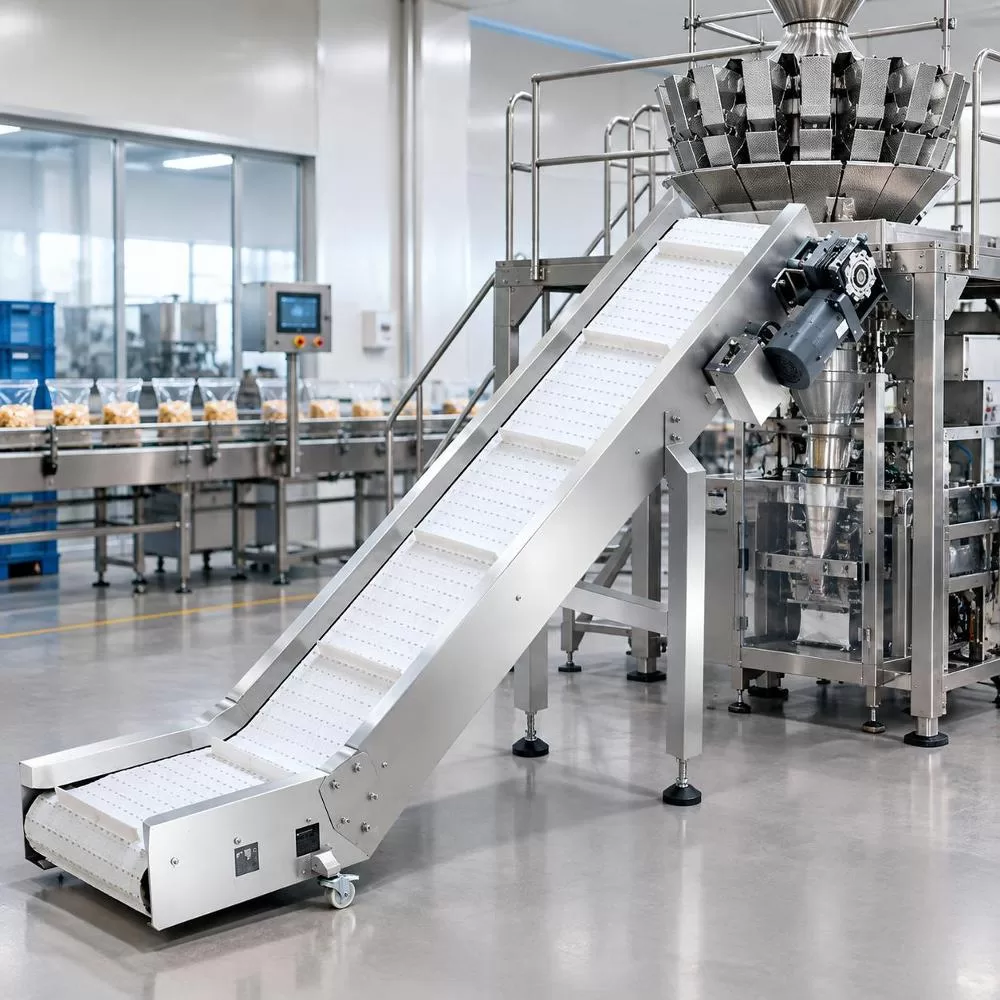
This article walks through what actually separates a dependable multihead weigher from one that looks good on a spec sheet but struggles on the floor. We’ll use a 14-head VFFS system, the CB-VG52B, as a working example of how these decisions play out in practice.
Why Weight Accuracy Becomes a Business Problem, Not Just a Technical One
Every gram of overfill on a bag of snacks or granules is product given away for free. Multiply that across a production run of thousands of bags, and the loss stops being trivial. It becomes a line item.
This is the actual reason multihead weighers exist. A single-head scale weighs one portion at a time, then stops to correct errors. A multihead system splits the target weight across many buckets, combines whichever combination lands closest to the set point, and dumps that combination in milliseconds. The math happens faster than a human could ever track it.
For a 14-head configuration like the CB-VG52B, more buckets mean more possible combinations per cycle. That translates into tighter accuracy without slowing the line down. According to the manufacturer’s specifications, this unit is rated at ±1g for weights under 100g, which matters a great deal for snack foods, spices, or small hardware components where even small deviations add up over a shift.
How Servo Control Changes the Reliability Equation
Accuracy at the weigher head is only half the story. The bagging mechanism downstream has to keep pace without introducing its own errors through sloppy film handling or inconsistent sealing.
This is where the drive system matters more than most buyers expect. The CB-VG52B uses a five-servo driver setup, with separate servos handling belt drawing, vertical sealing, and horizontal sealing independently. Instead of one motor trying to coordinate everything through mechanical linkages, each function gets its own precise control loop.
The practical effect shows up in bag consistency. Seals come out even. Film tension stays steady instead of drifting as the roll empties. Operators spend less time babysitting adjustments mid-shift, which is often the real cost nobody budgets for when comparing machines on paper.
Reading a Spec Sheet Like an Engineer, Not a Salesperson
Technical specifications are easy to skim past, but they’re where the real decision-making happens. Below is a breakdown of the CB-VG52B’s core specs, which doubles as a useful checklist for evaluating any comparable 14-head system.
| Specification | Value |
|---|---|
| Capacity | Up to 120 bags/min |
| Weigher Heads | 14 |
| Bucket Capacity | 1.3L |
| Accuracy | ±1g (for weights under 100g) |
| Bag Width | 50–250mm |
| Bag Length | 50–400mm |
| Filling Range | ≤4.1L |
| Reel Film Width | 120–520mm |
| Film Thickness | 0.04–0.09mm |
| Power / Voltage | 7kW / 220V, 50/60Hz |
| Air Consumption | 0.8MPa, 0.3m³/min |
| Dimensions | 1170 × 1930 × 1900mm |
| Weight | 800kg |
A few of these numbers deserve closer attention than others. Bucket capacity and filling range together tell you the realistic product size range a machine can handle before you need a different weigher entirely. Air consumption matters if your facility already runs several pneumatic machines off a shared compressor, since underestimating total draw is a common cause of pressure drops on a packed line.
Matching Bag Styles to Your Product and Retail Shelf
Not every product belongs in the same bag format, and this is a point that gets overlooked during machine selection. A gusseted bag that stands upright on a shelf behaves very differently from a flat pillow bag destined for a bulk bin.
The CB-VG52B is built to form several bag types without a full retooling between runs:
- Pillow bags for general snack and granule packaging
- Gusseted bags for products needing shelf stability
- Strip bags for multi-pack or portioned retail formats
- Euroslot bags for hang-sell retail displays
Flexibility here reduces the need to invest in a second machine just to serve a different retail channel. If your product line spans both bulk bags and hang-sell packs, this kind of range becomes a real factor in total cost of ownership, not just a bullet point on a brochure.
The Overlooked Role of Film Handling in Daily Uptime
Film jams and misaligned seals are among the most common reasons a packaging line stops mid-shift. It’s rarely the weigher that causes downtime. It’s almost always the film path.
Automatic film rectification keeps the film tracking straight as it unwinds, correcting drift before it becomes a wrinkle or an off-center seal. Combined with vacuum film pulling, this reduces the manual adjustments operators would otherwise make dozens of times per shift. For a line running continuously at up to 120 bags per minute, even a few seconds of correction per interruption adds up to meaningful lost output over a full day.
Reel film width on the CB-VG52B ranges from 120 to 520mm, with film thickness between 0.04 and 0.09mm. Those numbers set the practical boundaries for what packaging film your supplier needs to stock, which is worth checking against your current film contracts before switching machines.
Why Component Sourcing Quietly Determines Machine Lifespan
Ask any maintenance technician which part of a packaging machine fails first, and the answer is usually electrical or pneumatic components, not the structural frame. This is why the brand names behind the PLC, servos, valves, and switches matter more than most buyers initially assume.
The CB-VG52B uses Siemens PLC and servo motors, SMC pneumatic pistons, and Schneider switches. These are widely recognized industrial component brands, chosen specifically because replacement parts and technical support are easier to source globally compared to proprietary or unbranded alternatives. If a valve fails at 2am on a production line, the difference between a part sitting on a local distributor’s shelf and one that needs a six-week import lead time is the difference between a short delay and a lost week of output.
Operator Interface and Why Simplicity Reduces Errors
A machine with excellent mechanical precision can still underperform if the control interface is confusing. Operators under time pressure make mistakes on cluttered screens, and those mistakes often show up as weight drift or misfeeds.
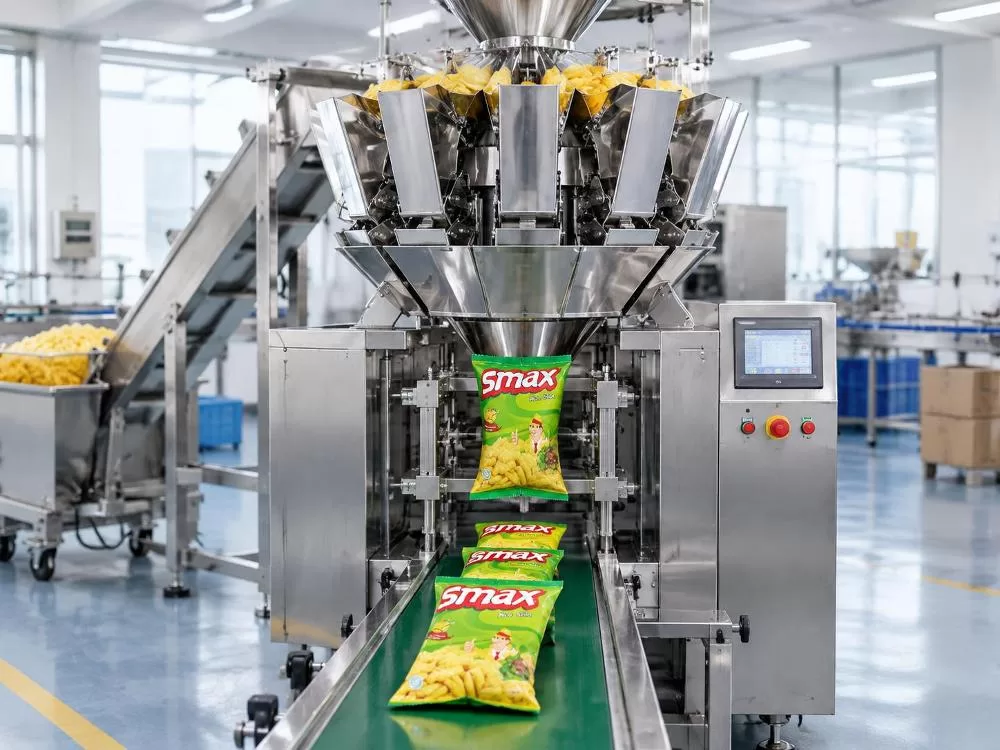
The CB-VG52B uses a 10-inch touch screen for recipe selection, speed adjustment, and diagnostics. A removable electrical panel design also simplifies maintenance access, letting technicians service components without disassembling the entire housing. For facilities running multiple shifts with varying operator experience levels, a straightforward interface shortens training time and lowers the chance of avoidable downtime from input errors.
Common Questions Buyers Ask When Comparing Weigher Options
Does a higher head count always mean better accuracy?
Not strictly. Accuracy depends on the combination of head count, bucket design, and the control algorithm selecting combinations. A 14-head system is well suited to mid-range product volumes and bag sizes, but extremely small or extremely large target weights may call for a different head count to stay efficient.
Can one machine really handle multiple bag styles without major changeovers?
On systems designed for it, yes. The CB-VG52B’s forming structure accommodates pillow, gusseted, strip, and euroslot formats through adjustment rather than full retooling, though some settings and film specifications still need to be matched to the chosen format.
How much does air supply quality affect weigher performance?
Pneumatic components are sensitive to moisture and pressure fluctuation. Consistent air supply at the rated 0.8MPa helps maintain sealing and feeding precision, so facilities with marginal compressor capacity should factor this into their planning before installation.
What This Means for Your Equipment Decision
Selecting among multihead weigher manufacturers ultimately comes down to matching machine capability to your actual product mix, not chasing the highest number on a spec sheet. Bucket count, servo configuration, film handling, and component sourcing all interact to determine whether a line runs smoothly or needs constant attention.
For companies evaluating a 14-head system like the CB-VG52B, the technical details outlined here, accuracy tolerance, bag format range, film specifications, and component brands, offer a practical framework for comparing options rather than relying on marketing claims. Baopack has worked in automatic packaging equipment since 2001, and for us, these details reflect what buyers consistently ask about before committing to a line investment. Among multihead weigher manufacturers, the ones worth serious consideration are the ones willing to walk through these numbers in detail rather than skip past them.


-
VFFS Equipment: The Ultimate Guide to Vertical Form Fill Seal Technology
13-03-2026 -
The Essential Guide to Weight Packing Machines for Precision Weighing
12-03-2026 -
Power Packing Machine: The Ultimate Guide to Heavy-Duty Packaging Efficiency
11-03-2026 -
Weigher Packing Machine: The Definitive Guide to Precision Weighing & Packaging
10-03-2026 -
Auger Type Powder Filling Machine: The Ultimate Guide to Precision Packaging
09-03-2026 -
Advanced Packing Solutions: Snacks, Sugar, and Frozen Food Machines
29-10-2025 -
Efficient and Reliable Solutions for Salt, Nuts, and Frozen Dumplings Packing
29-10-2025 -
High-Performance Biscuits, Lollipop, and Ketchup Packing Machines for Modern Food Production
29-10-2025 -
Efficient Liquid Filling and Packing Machines for Modern Production
23-10-2025 -
Reliable Granule Packaging Machines for Efficient Production
23-10-2025
