
How Horizontal Premade Pouch Systems Changed High-Volume Production
Walk into any modern beverage plant or snack manufacturing facility, and you’ll notice something: the machines have gone horizontal. This shift didn’t happen by accident. Horizontal premade pouch packaging machines emerged as manufacturers faced a specific problem—vertical systems couldn’t keep up with the demand for speed, flexibility, and space efficiency that contemporary production lines required.
Traditional vertical form-fill-seal machines create pouches from roll stock in real time. They work well for simple applications, but when production managers need to switch between stand-up pouches, zipper bags, and spouted formats multiple times per shift, the changeover time becomes a bottleneck. Horizontal systems eliminate this constraint by accepting pre-formed pouches, allowing operators to swap formats in minutes rather than hours.
Why Production Lines Moved Away From Vertical Systems
Vertical machines dominated packaging for decades because they were straightforward: film comes in, product goes in, sealed pouch comes out. The problem emerged when product portfolios expanded. A single production line might need to package coffee in one-way valve bags in the morning, then switch to resealable zipper pouches for dried fruit by afternoon.
Vertical systems require extensive mechanical adjustments for such changes. Operators must modify forming collars, adjust sealing bars, and recalibrate film tension. Each changeover consumes 30 to 90 minutes, depending on the complexity of the pouch format. For facilities running multiple SKUs daily, this downtime translates directly to lost production capacity.
Horizontal premade pouch machines sidestep this issue entirely. Since pouches arrive pre-formed from a supplier, the machine only needs to perform three operations: open the pouch, fill it, and seal it. Format changes require swapping the pouch magazine and adjusting gripper settings—tasks that typically take under 10 minutes.
Space utilization also drives the horizontal preference. Vertical machines extend upward, often requiring clearance heights of 3 to 4 meters. Horizontal systems maintain a lower profile, fitting beneath standard industrial ceiling heights while offering comparable or superior throughput.
Core Mechanism: How Horizontal Systems Process Pouches
A horizontal premade pouch machine operates through a series of synchronized stations arranged along a linear track. Pouches enter from a magazine, where vacuum or mechanical grippers pick them individually. The machine then carries each pouch through several distinct zones.
The opening station uses vacuum cups or mechanical fingers to separate the pouch walls. This step is critical—inadequate opening leads to filling errors and product waste. Advanced systems incorporate sensors that verify full pouch opening before allowing the cycle to continue.
Once opened, the pouch moves to the filling station. Depending on the product, this could involve auger fillers for powders, volumetric cups for granules, or liquid pumps for beverages. The CB-180, for instance, achieves filling speeds of 30 to 40 bags per minute while maintaining accuracy through servo-driven dosing mechanisms.
After filling, the pouch advances to the sealing zone. Heat bars compress the pouch opening while applying controlled temperature, creating an airtight seal. Some applications require additional features like zipper integration or gas flushing for modified atmosphere packaging. These operations occur in sequence without removing the pouch from the carrier chain.
The final station ejects completed pouches onto a conveyor for downstream operations such as secondary packaging or quality inspection. The entire process—from magazine pickup to ejection—typically takes 1.5 to 2 seconds per pouch.
Material Construction and Its Impact on Longevity
Equipment lifespan in packaging environments depends heavily on material choice. Many machines use 304 stainless steel for structural components, which provides adequate corrosion resistance for dry applications. However, facilities handling acidic products, brines, or cleaning chemicals face accelerated deterioration.
The CB-180 addresses this through 316-grade stainless steel on all product-contact surfaces. This alloy contains molybdenum, which significantly improves resistance to chloride-induced pitting and crevice corrosion. In practice, this means machines maintain structural integrity in wet production environments where 304 steel would develop surface degradation within 18 to 24 months.
The main frame uses carbon steel with epoxy coating, a pragmatic choice. Non-contact structural elements don’t require stainless steel’s corrosion resistance, so using carbon steel reduces equipment cost without compromising durability. The 304 stainless steel cover panels protect internal components while maintaining a cleanable exterior.
This tiered material strategy balances cost against functional requirements. Production facilities benefit from extended maintenance intervals and reduced replacement part expenses over the machine’s operational life.
Servo Technology and Filling Precision
Older packaging machines relied on mechanical cam systems for motion control. Cams work, but they’re inflexible. Changing bag sizes or fill volumes often meant physically replacing cams—a time-consuming mechanical task requiring specialized tools.
Modern horizontal systems use servo motors for critical movements. Servos respond to electronic commands, allowing operators to adjust parameters through the control interface rather than with wrenches. The CB-180 employs Siemens servo motors for gripper positioning, film advancement, and sealing bar actuation.
This shift to servo control delivers several operational advantages:
- Fill volume adjustments happen through software, enabling recipe changes between batches without mechanical intervention
- Positional accuracy improves because servos maintain consistent positioning regardless of load variations
- Diagnostic data becomes available, as servos report torque, position, and fault conditions to the PLC
The practical outcome: operators can fine-tune packaging parameters in real time based on product characteristics or quality requirements. A bakery switching from light croissants to dense bagels can adjust gripper pressure and filling speed without stopping production for manual adjustments.
Application-Specific Configurations
Horizontal premade pouch machines aren’t monolithic. Base models accept standard modification for specific product categories, each with distinct handling requirements.
Liquid Products: Pouches containing beverages, sauces, or oils require drip-prevention nozzles and precise volumetric control. Machines often incorporate flow meters that monitor fill volume in real time, automatically compensating for viscosity changes due to temperature fluctuation.
Powders and Granules: Free-flowing products like coffee, flour, or pet food generate dust during filling. Systems handling these materials need dust extraction around the fill station and may incorporate auger feeders or volumetric cup fillers depending on particle size distribution.
Chunky or Irregular Products: Nuts, candy pieces, or dried vegetables present handling challenges. Vibratory feeders orient products before filling, while multi-head weighers ensure accurate portions despite piece-to-piece weight variation.
Modified Atmosphere Packaging: Products requiring extended shelf life often use nitrogen or carbon dioxide flushing. Machines equipped for MAP include gas injection nozzles at the fill station and residual oxygen analyzers that verify atmosphere composition before sealing.
The CB-180’s design accommodates these variations through modular stations. Facilities can start with a basic configuration and add capabilities as product lines expand, avoiding the capital expense of purchasing entirely new equipment.
| Product Category | Typical Filling Method | Common Speed Range | Additional Requirements |
|---|---|---|---|
| Beverages | Volumetric pump | 25-35 bags/min | Gas flushing, drip prevention |
| Ground coffee | Auger filler | 30-45 bags/min | Dust extraction, one-way valves |
| Snack foods | Multi-head weigher | 35-50 bags/min | Modified atmosphere, gentle handling |
| Powdered supplements | Auger or volumetric cup | 25-40 bags/min | Clean-in-place capability, dust control |
| Frozen vegetables | Combination weigher | 30-40 bags/min | Cold environment materials, moisture resistance |
Integration With Upstream and Downstream Equipment
An automatic packaging machine rarely operates in isolation. Production efficiency depends on how well the system connects with material handling equipment before and after the packaging station.
Upstream Integration: Product arrives at the machine through conveyors, bucket elevators, or pneumatic transfer systems. The packaging machine’s PLC communicates with these feeders to maintain consistent material flow. If the pouch magazine runs low, the system signals upstream equipment to pause, preventing product accumulation and potential spills.
Downstream Considerations: Filled pouches exit the machine at rates of 30 to 60 per minute. Conveyor systems must match this pace while orienting pouches for the next operation—typically cartoning, case packing, or palletizing. Sophisticated lines use vision systems to verify seal integrity and pouch orientation before products advance to secondary packaging.
For operations handling hazardous materials or products requiring explosive atmosphere protection, the CB-180 incorporates air-proof and explosion-proof capabilities. These features allow installation in classified environments without requiring separate enclosures or isolation barriers.
Facilities often add auxiliary equipment to expand capability:
- Nitrogen generators for on-site MAP gas production
- Vacuum systems for atmospheric removal before sealing
- Vibrating tables or conveyors to settle product within pouches
- Air compressors sized for the machine’s pneumatic requirements (0.6 to 1.2 m³/min in this case)
Control Systems and Operational Interface
The shift from mechanical to electronic control fundamentally changed how operators interact with packaging equipment. Touch screen interfaces replaced rows of switches and dials, centralizing machine control and providing real-time production data.
The CB-180 uses a YOUNGSUN touch screen connected to a Siemens PLC. This combination allows operators to:
- Monitor current production speed and bag count
- Adjust filling parameters without stopping the machine
- View diagnostic alerts when sensors detect issues
- Access stored recipes for different products or pouch formats
The interface displays machine status through color-coded indicators. Green confirms normal operation, yellow warns of conditions requiring attention (low pouch count, for example), and red signals faults that require immediate response.
Production managers benefit from data logging capabilities. The system records cycle times, fill volumes, and downtime events, providing metrics for efficiency analysis and maintenance planning. This data visibility helps identify bottlenecks and optimization opportunities that weren’t apparent with older mechanical systems.
Maintenance Accessibility and Downtime Reduction
Equipment uptime directly impacts production capacity. A machine that runs reliably with minimal maintenance delivers more value than a faster system that requires frequent intervention.
Horizontal premade pouch machines generally offer better maintenance access than vertical systems. The linear layout places critical components—grippers, sealing bars, sensors—at waist height where technicians can reach them without ladders or platforms. The CB-180’s design specifically allows disassembly of wear components without disturbing adjacent systems.
Regular maintenance tasks include:
- Inspecting and cleaning gripper surfaces (weekly)
- Checking sealing bar temperature calibration (weekly)
- Verifying sensor alignment and cleanliness (bi-weekly)
- Lubricating chain and bearing points (monthly)
- Examining pneumatic lines for leaks (monthly)
The machine’s use of SCHNEIDER transducers and SMC pneumatic components provides readily available replacement parts through industrial distribution networks. This contrasts with systems using proprietary components that require ordering from the original manufacturer, often with extended lead times.
Preventive maintenance intervals extend when equipment operates within designed parameters. Overloading the machine by running pouches outside specified size ranges or exceeding rated speed accelerates wear on grippers and sealing mechanisms.
Sizing Flexibility and Changeover Speed
Production facilities handling multiple products need packaging equipment that adapts quickly to format changes. Horizontal systems excel here because pouch dimensions are fixed by the supplier rather than created by the machine.
The CB-180 accommodates pouches from 150 to 210 mm in width and 200 to 300 mm in length. Within this range, format changes follow a straightforward process:
- Load new pouch format into the magazine
- Adjust gripper width through the touch screen interface
- Modify fill volume if product quantity changes
- Update sealing temperature for different film structures
- Verify proper operation through a test cycle
Experienced operators complete these steps in 8 to 12 minutes. Compare this with vertical machines, where film path adjustments and forming collar changes consume 45 to 90 minutes per changeover.
This speed advantage becomes significant for contract packagers or facilities with diverse product lines. A co-packer running three different products per shift on a horizontal system achieves 30 to 60 minutes more production time daily compared to using vertical equipment—time that translates directly to additional units packed and revenue generated.
Energy Requirements and Facility Planning
Installing an automatic packaging machine affects facility infrastructure beyond floor space. Electrical capacity, compressed air supply, and environmental controls all factor into implementation planning.
The CB-180 requires 380V three-phase power at 8 kW. This is moderate for industrial equipment; most production facilities have adequate electrical service. The machine draws peak power during start-up when servo motors initialize and heat bars reach operating temperature. Once running, power consumption stabilizes at 65-75% of rated capacity.
Pneumatic requirements total 0.6 to 1.2 m³/min at 6 to 8 bar pressure. Facilities must verify that existing air compressor capacity can support the machine plus other pneumatic equipment on the line. Undersized air supply causes erratic gripper operation and incomplete pouch opening.
Ambient temperature affects machine performance. Most horizontal systems operate reliably between 5°C and 40°C, but temperature swings impact film characteristics and sealing consistency. Facilities in regions with extreme temperatures often condition the packaging area to maintain stable operating conditions.
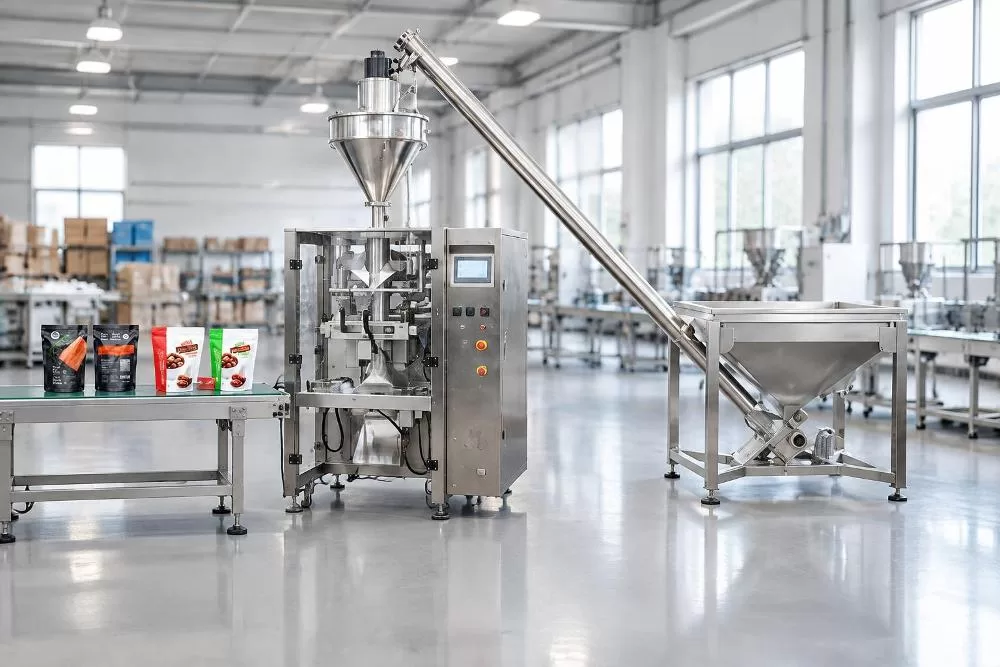
Safety Features and Operator Protection
Modern packaging equipment incorporates multiple safety mechanisms to protect operators from moving components and prevent accidents during operation or maintenance.
Emergency stop buttons appear at multiple locations on the CB-180, allowing operators to halt machine motion immediately from any position around the equipment. These buttons trigger a controlled stop rather than cutting power abruptly, preventing damage to pouches currently in process.
Transparent protective panels enclose moving parts while maintaining visibility for monitoring. Interlocked access doors cut power to specific zones when opened, preventing operation during maintenance. This zone-specific lockout allows technicians to work on one section while other areas remain operational.
Light curtains or area scanners detect operator presence in hazardous zones and automatically reduce machine speed or stop movement. These systems respond faster than mechanical guards while providing flexible protection that adapts to different operational modes.
The machine’s PLC monitors operational parameters continuously. If sensors detect anomalies—excessive motor torque, temperature deviations, or timing faults—the system executes a controlled shutdown and displays diagnostic information on the touch screen. This predictive approach prevents catastrophic failures that could injure operators or damage products.
Decision Framework for Horizontal System Adoption
Selecting between horizontal and vertical packaging approaches depends on specific operational requirements rather than blanket preferences. Several factors guide this decision:
Product Portfolio Complexity: Facilities running more than three different pouch formats daily see stronger benefits from horizontal systems due to reduced changeover time. Single-product operations may find vertical machines adequate.
Available Floor Space: Horizontal equipment requires more linear space but less vertical clearance. Facilities with low ceilings or limited headroom favor horizontal configurations.
Throughput Requirements: Both system types achieve similar speeds (30-60 bags/min for typical applications), so raw speed alone doesn’t determine the choice. Effective throughput—accounting for changeover time and downtime—often favors horizontal systems in multi-product environments.
Film vs. Premade Pouch Economics: Vertical machines use less expensive roll stock film, while horizontal systems require pre-formed pouches. The cost difference narrows as pouch volume increases and suppliers achieve economies of scale. Calculate total cost including labor, downtime, and waste when comparing options.
Maintenance Resources: Horizontal systems generally offer simpler maintenance access, reducing the skill level required for routine tasks. Facilities with limited technical staff or high turnover may find this accessibility valuable.
For us, the CB-180 represents a practical entry point into horizontal packaging. The machine handles common production requirements—moderate speeds, standard pouch sizes, and mainstream products—while maintaining the build quality and component selection that ensure reliable long-term operation.
Real-World Performance Considerations
Specification sheets provide one perspective on equipment capability, but actual production environments introduce variables that affect performance. Understanding these factors helps set realistic expectations and optimize operations.
Product Characteristics: Free-flowing materials like sugar or rice reach stated machine speeds easily. Sticky products like honey or products with uneven pieces require slower operation to maintain accuracy and prevent jams.
Pouch Film Quality: Consistent film thickness and sealing layer uniformity directly impact success rates. Switching pouch suppliers sometimes requires adjusting sealing temperature or dwell time to maintain seal integrity.
Operator Skill Level: Trained operators who understand machine behavior anticipate issues and make minor adjustments before problems escalate. Investment in operator training typically returns value through reduced downtime and improved output quality.
Environmental Factors: Humidity affects static electricity generation, which influences film handling. Facilities in extremely dry or humid climates may need to adjust gripper vacuum levels or add static elimination equipment.
Machines like the CB-180 incorporate adjustment range to accommodate these real-world variations. The servo-driven systems and programmable controls allow fine-tuning that mechanical systems couldn’t match, helping operations maintain consistent performance despite environmental or material fluctuations.
Horizontal premade pouch packaging machines represent an evolution in automated packaging—one driven by production realities rather than theoretical advantages. They emerged because manufacturers needed flexibility, because changeover time affected profitability, and because product portfolios became too complex for single-format equipment. The technology succeeded because it solved tangible problems that operators faced daily. As production demands continue diversifying, the horizontal approach offers a practical response to the complexity modern packaging operations now consider routine.


-
VFFS Equipment: The Ultimate Guide to Vertical Form Fill Seal Technology
13-03-2026 -
The Essential Guide to Weight Packing Machines for Precision Weighing
12-03-2026 -
Power Packing Machine: The Ultimate Guide to Heavy-Duty Packaging Efficiency
11-03-2026 -
Weigher Packing Machine: The Definitive Guide to Precision Weighing & Packaging
10-03-2026 -
Auger Type Powder Filling Machine: The Ultimate Guide to Precision Packaging
09-03-2026 -
Advanced Packing Solutions: Snacks, Sugar, and Frozen Food Machines
29-10-2025 -
Efficient and Reliable Solutions for Salt, Nuts, and Frozen Dumplings Packing
29-10-2025 -
High-Performance Biscuits, Lollipop, and Ketchup Packing Machines for Modern Food Production
29-10-2025 -
Efficient Liquid Filling and Packing Machines for Modern Production
23-10-2025 -
Reliable Granule Packaging Machines for Efficient Production
23-10-2025
