
Automatic Packaging Machine Solutions for Fragile, Irregular Snacks
Fragile snacks break the rules of standard packaging equipment. Egg rolls, wafer sticks, and crunchy candies do not flow through a hopper the way rice or granules do. Their shapes are inconsistent, their shells are thin, and they crack under pressure that a rigid box or a pouch of pasta would never notice. This is precisely why an automatic packaging machine built for this category needs a different approach to feeding, not just a faster sealing head.
Manufacturers who try to force irregular, brittle products through generic flow wrapping lines often end up with broken snacks, inconsistent bag counts, and a packaging floor full of rejects. An automatic packaging machine designed specifically around rotary feeding solves the alignment problem before the sealing stage even begins, which is where most breakage actually starts.
Why Irregular Snacks Break Standard Feeding Systems
Most packaging lines assume the product arriving at the infeed is already uniform. Bottles stand up. Sachets stack flat. Egg rolls do neither. They roll, tumble, and settle at random angles on a belt, so a straight conveyor pushes them into the wrapper unevenly spaced and often overlapping.
That misalignment forces the sealing jaws to compensate, and compensation usually means crushing. A cracker that enters the flow wrapper sideways gets pinched at the fin seal. A candy that arrives at an angle jams the cutting knife. The result is not a sealing defect, it is a feeding defect that shows up downstream.
The practical fix has to happen earlier in the line. Products need to be organized into a single, aligned stream before they ever reach the film. That is a mechanical sorting problem, not a sealing problem, and it explains why specialized feeding equipment exists as its own category within packaging automation rather than as an accessory bolted onto a standard wrapper.
How Rotary Feeding Aligns Fragile Products
The Egg Roll Rotary Feeder Automatic Packaging Machine Line addresses this with a rotating plate stacking mechanism. Instead of pushing product forward in a straight line, the rotary disc uses centrifugal force to spread and settle irregular items around its circumference.
As the plate turns, gravity and rotational force work together to nudge each piece into its own position along the rim. Think of it the way a roulette wheel distributes a ball into a single pocket, except here the goal is a continuous stream rather than one resting point. Products exit the rotary section already spaced and aligned, feeding into the linear conveyor in single file.
This matters for breakage rates specifically. According to the product’s design documentation, feeding tapes and stacking plates run on analog speed control, which allows the transfer speed to be tuned finely rather than locked into fixed steps. Slower, controlled handling at the transition points is what keeps a thin-walled egg roll shell intact through the whole cycle.
Core Technical Specifications
Selecting the right automatic packaging machine for fragile snacks means checking whether the mechanical envelope actually matches your product size and target output. Below is the specification range for this line.
| Parameter | Value |
|---|---|
| General Power | 6.6 KW |
| Bag Length | 90–180 mm |
| Bag Width | 30–90 mm |
| Bag Height | 5–40 mm |
| Packaging Film Width | 120–210 mm |
| Packaging Speed | 70–600 bags/min |
| Machine Weight | 1400 kg |
| Dimensions | 1885 x 890 x 1860 mm |
| Power Supply | 1AC 220V 50HZ |
A speed range this wide, from 70 up to 600 bags per minute, tells you the same base machine can serve a small regional producer running short batches and a larger snack manufacturer running continuous shifts. The bag height ceiling of 40 mm is also worth noting, since it caps how thick a product can be before the rotary feeder loses its alignment advantage.
Film Compatibility and Product Contact Surfaces
Packaging film choice affects both shelf appearance and barrier performance, and this line is built to run several common substrates without requiring a different machine for each one.
Compatible materials include:
- OPP (oriented polypropylene), commonly used for its clarity and printability
- PE (polyethylene), often chosen for cost efficiency on lower-barrier products
- PVC and CPP for varying stiffness and sealing characteristics
- PTPE and KOP films for specific barrier or gloss requirements
- Aluminum film, typically selected when light and moisture exposure need tighter control
On the product contact side, the conveyor belts are food-grade and anti-microbial blue PU as the standard configuration, with white PU belts offered where a facility’s hygiene protocol calls for it. For a line handling ready-to-eat items with no further cooking step before the consumer opens the bag, belt material is not a cosmetic detail. It is part of the food safety chain.
Operating the Line Day to Day
Even a mechanically sound feeding system creates little value if operators struggle to run it or if maintenance eats into production hours. Two design choices in this line target that concern directly.
- The touch screen interface centralizes monitoring and adjustment, so operators do not need to memorize separate control panels for the feeder and the wrapper sections.
- The linear feeder conveyor belt is built for tool-free replacement, meaning a worn belt does not translate into an extended downtime window while maintenance staff search for the right wrench.
These two points matter more on a line running multiple shifts, where every hour of unplanned stoppage compounds against daily output targets. A packaging line’s real cost is rarely the purchase price. It is the sum of every minute it sits idle over its working life.
Where This Feeding Approach Fits in a Production Line
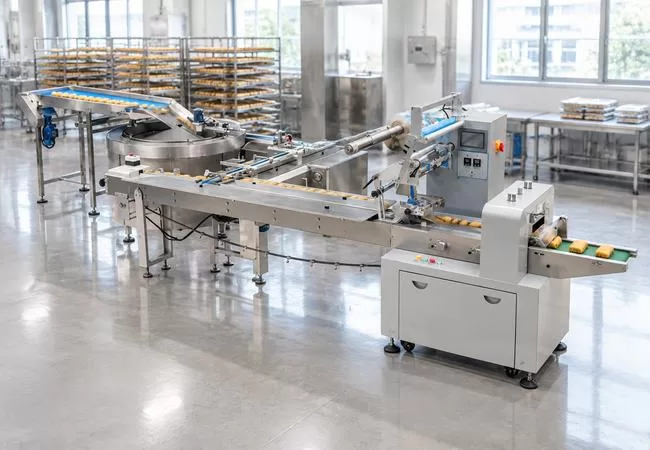
This automatic packaging machine line is suited to a specific set of production scenarios rather than general-purpose flow wrapping. Typical applications include:
- Packaging fragile snacks such as egg rolls, wafer rolls, and crackers
- Automated handling of crunchy candies prone to chipping under pressure
- Integration into an existing production line that currently handles irregular materials manually
- Either manual or automated feeding setups upstream of high-speed flow wrapping
Producers currently hand-feeding a flow wrapper with irregular snacks are usually the ones who feel this gap first. Manual feeding caps line speed to whatever a person can consistently place by hand, and it introduces the kind of inconsistency that automated alignment is meant to remove.
Choosing Between Manual and Rotary Feeding
Deciding whether a rotary feeder is worth adding to a line comes down to a short set of practical questions rather than a blanket recommendation.
- Product fragility: If breakage during hand feeding is already a measurable cost, mechanical alignment reduces the handling steps where cracking occurs.
- Target throughput: Lines aiming above what manual feeding can sustain, generally in the higher end of the 70–600 bags per minute range, benefit most from automated alignment.
- Labor availability: Facilities facing staffing shortages on repetitive feeding tasks often see the fastest return by automating that single station first.
- Product shape consistency: Highly irregular shapes gain more from rotary centrifugal alignment than products that were already close to uniform.
If none of these pressures apply yet, a simpler manual feed into a standard flow wrapper may still be adequate. Automation earns its cost when the problem it solves is already visible on the production floor.
Frequently Asked Questions
Does a rotary feeder work for products other than egg rolls?
The rotating plate mechanism is designed around irregular, fragile shapes generally, so crackers and crunchy candies are cited applications alongside egg rolls. Suitability still depends on matching the product’s dimensions to the bag length, width, and height ranges above.
Will switching film types require retooling the machine?
The line is built to run OPP, PE, PVC, CPP, PTPE, KOP, and aluminum film. Changing film types typically involves a changeover procedure rather than a mechanical rebuild, though sealing parameters may need adjustment for different film thicknesses.
How does analog speed control reduce breakage compared to fixed-speed feeding?
Analog control allows the feeding tape and stacking plate speeds to be tuned incrementally rather than switched between preset steps. Finer control at transfer points reduces the impact force fragile products experience during handoffs.
Can this line run at low speeds for small-batch production?
Yes. The stated packaging speed range starts at 70 bags per minute, which accommodates smaller runs, and scales up to 600 bags per minute for higher-volume operations.
Fragile food products will keep punishing packaging lines that treat feeding as an afterthought. The core lesson from rotary feeder design is that alignment has to happen before sealing, not during it. For manufacturers evaluating an automatic packaging machine for egg rolls, crackers, or similarly delicate snacks, the feeding mechanism deserves at least as much scrutiny as the sealing speed on the spec sheet. Baopack develops this category of equipment as part of its broader automatic packaging machine range, built for producers who need fragile products to arrive at the shelf intact rather than crushed somewhere on the line.


-
VFFS Equipment: The Ultimate Guide to Vertical Form Fill Seal Technology
13-03-2026 -
The Essential Guide to Weight Packing Machines for Precision Weighing
12-03-2026 -
Power Packing Machine: The Ultimate Guide to Heavy-Duty Packaging Efficiency
11-03-2026 -
Weigher Packing Machine: The Definitive Guide to Precision Weighing & Packaging
10-03-2026 -
Auger Type Powder Filling Machine: The Ultimate Guide to Precision Packaging
09-03-2026 -
Advanced Packing Solutions: Snacks, Sugar, and Frozen Food Machines
29-10-2025 -
Efficient and Reliable Solutions for Salt, Nuts, and Frozen Dumplings Packing
29-10-2025 -
High-Performance Biscuits, Lollipop, and Ketchup Packing Machines for Modern Food Production
29-10-2025 -
Efficient Liquid Filling and Packing Machines for Modern Production
23-10-2025 -
Reliable Granule Packaging Machines for Efficient Production
23-10-2025
