

Net Weight Filling Machine: Precision Gravimetric Dosing for Modern Packaging Lines
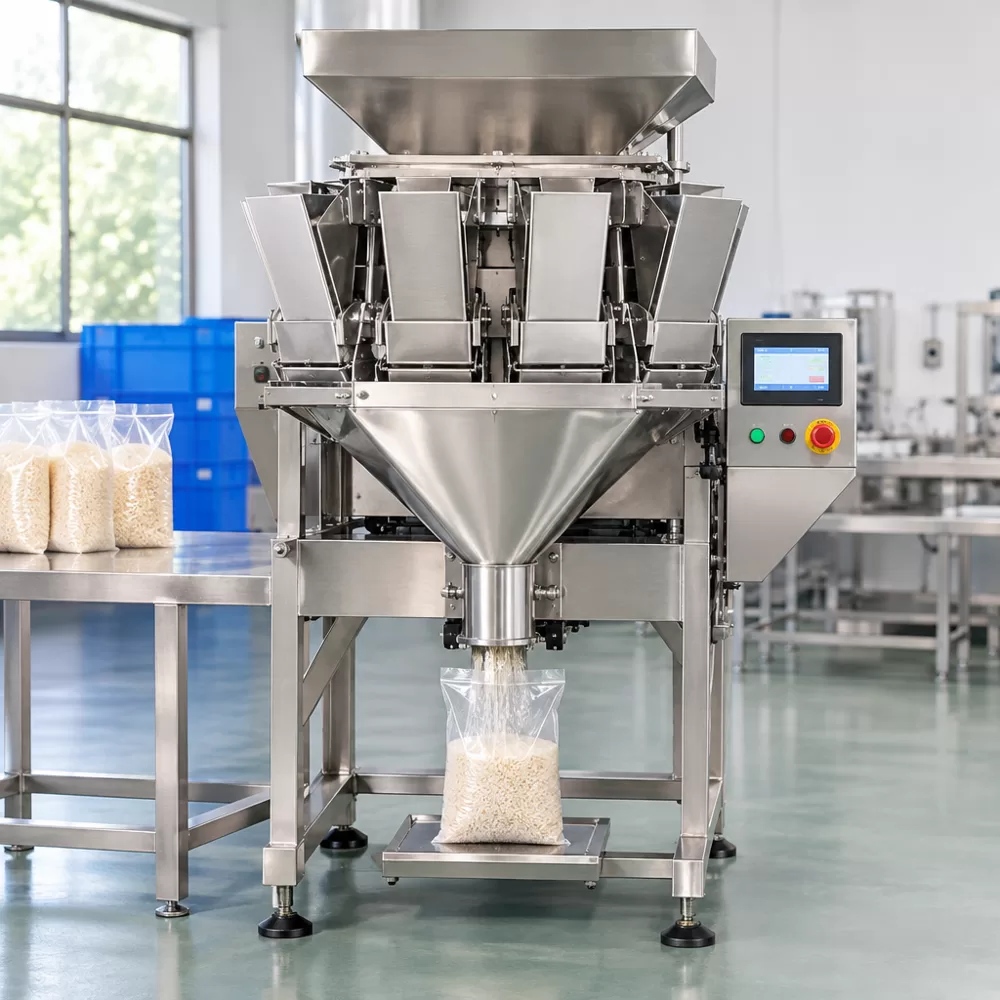
Operating an industrial bagging line requires continuous balance between packaging speed and dispensing accuracy. When dry goods experience bulk density variations, relying on fixed-volume cup or auger fillers often leads to inconsistent fill weights across batches. Integrating a dedicated net weight filling machine addresses this issue by weighing the product load inside an isolated bucket before discharging it into the bag. Measuring the actual mass directly insulates the packaging line from product compaction shifts, protecting operating margins across high-volume production schedules.
Understanding Net Weight Filling: Gravimetric Precision vs. Volumetric Systems
Gravimetric Dosing Principles and Net Weight Classification
Gravimetric filling encompasses dosing systems where product mass is measured directly by load sensors rather than estimated by volume. Under technical standards such as OIML R 61, automatic gravimetric filling instruments assemble individual loads of predetermined mass by direct weighing. In dedicated net weight filling instruments, the product is measured separately in one or more weigh buckets before entering the container, isolating the product mass from tare variations. In contrast, gross weight fillers weigh the container and incoming material together, which requires tare subtraction for each container to avoid packaging weight inconsistencies.
By establishing target mass inside an isolated weighing chamber, net weight dosing removes dependence on container uniformity during the measurement stage. However, measuring product in a separate hopper does not remove the need for finished product inspection, because dynamic product transfer, dust settlement, or hopper residue can still introduce discrepancies between discharge and final pouch sealing. Quality assurance teams still establish routine checkweighing protocols to audit sealed packages downstream, verifying that target fill values match the stated label quantity under practical operational tolerances.
The Mechanics of Bulk Density Fluctuations
Granular dry goods frequently exhibit density variations during ongoing packaging operations. Variations in raw material harvest moisture, ambient factory humidity, and particle consolidation at the bottom of storage hoppers alter how tightly individual granules pack together. Volumetric fillers calculate fill quantities by physical volume, such as a cavity displacement or auger flight turn. When material density shifts, identical physical volumes produce different total package weights, resulting in either unrecorded product giveaway or illegal underfilling across production runs.
When product compaction increases bulk density, volumetric filling devices inadvertently dispense excessive material into every container. Over prolonged operational schedules, continuous unmeasured giveaway creates substantial economic losses for packaging plants running expensive ingredients. Conversely, when product becomes aerated and less dense, volumetric filling yields underweight packages that risk regulatory fines. Net weight filling systems overcome this limitation by continuously tracking true material mass, providing direct feedback that helps reduce fill-weight errors caused by volumetric settling.
Regulatory Compliance and Statistical Process Control
Commercial packaging operations must comply with rigorous legal net-content standards, such as those documented in NIST Handbook 133 and related international metrology frameworks. These regulatory guidelines require that the average net content of sampled production lots equals or exceeds the declared label quantity, while also restricting the quantity of individual packages exhibiting shortfalls beyond defined Maximum Allowable Variations. Meeting these requirements requires managing both the lot mean and the statistical distribution of individual dispenses.
Deploying a net weight filling machine allows plant engineers to reduce process variation, tightening standard deviations across production runs. Narrowing the weight distribution enables plant operators to lower target safety margins closer to label specifications while continuing to comply with lot average and shortfall criteria. However, setting the operational target still requires balancing process capability, statistical measurement uncertainty, and physical material flow behavior rather than presuming zero shortfall risk.
Mechanical Architecture of High-Accuracy Gravimetric Systems
Linear Vibration Feeders and Two-Stage Dosing
Gravimetric filling machines commonly achieve accurate mass cutoff through multi-stage linear vibration feeding. Bulk product transfers from an overhead supply bin onto stainless steel vibratory trays that guide material toward the suspended weigh bucket. Dosing generally proceeds across coarse and fine feed stages, where the feeder initially operates at higher amplitude to deliver the bulk of the batch before transitioning to a throttled dribble mode to finalize the target mass.
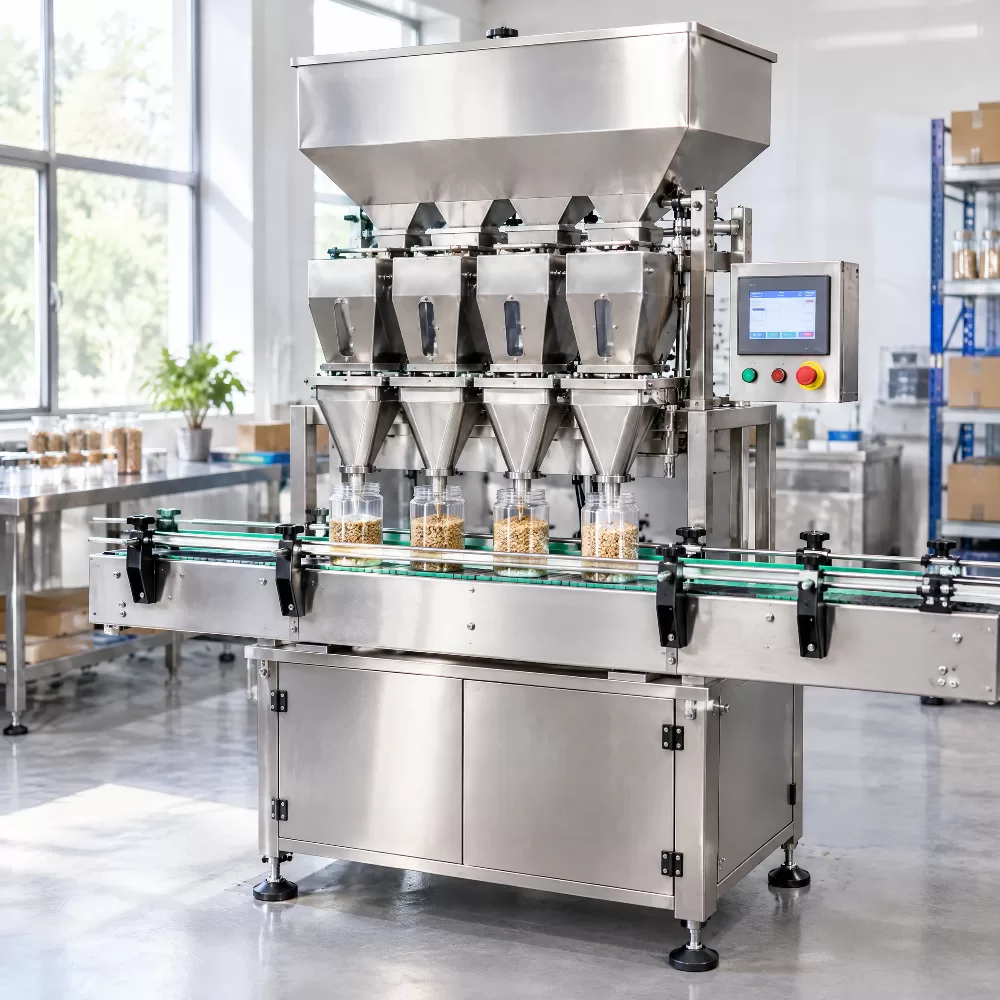
During the fine dribble stage, the vibration amplitude decreases to dispense a thin, controlled stream of material, facilitating a precise cutoff. System controllers compensate for material remaining suspended in the air between the feeder pan edge and the bucket at the moment the feed shuts down. Correctly programming in-flight compensation parameters prevents product overshoots and accommodates shifting flow characteristics as material properties change throughout production shifts.
Load Cell Signal Processing and Dynamic Filtering
Industrial gravimetric fillers incorporate sensitive strain-gauge load cells coupled with digital signal processing electronics. Factory production floors produce significant mechanical noise, including vibrations from adjacent packaging drives, floor transport, and support framework movement. Digital signal filters dampen these cyclic plant disturbances, though system engineers must calibrate filter parameters to maintain a balance between signal stabilization time and overall packaging cycle speed.
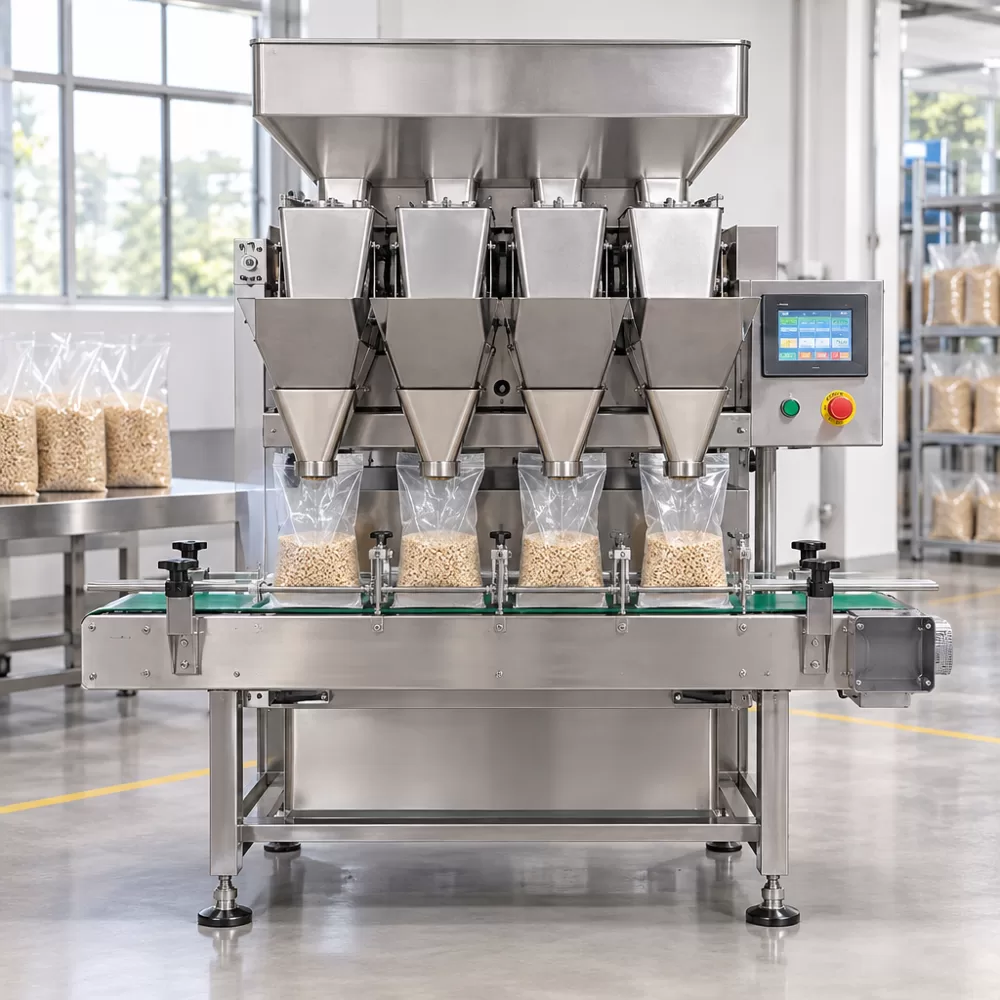
The controller must register a stable weight value after product reaches the weigh hopper, accounting for dynamic impact forces caused by falling granules. Rigid mechanical decoupling of the weighing platform from adjacent bag-forming equipment prevents motor torque and mechanical indexing shocks from corrupting sensitive gram-level readings. Maintaining structural rigidity and proper mechanical isolation ensures load cells record static material mass accurately under continuous operating conditions.
Weigh Hopper Discharge and Cyclic Operation
After the target weight is registered and stabilized in the bucket, an actuation system opens the hopper discharge doors to drop the product. Fast-acting discharge mechanisms provide clean releases, reducing residual product hang-up along the interior surfaces of the dosing hopper. Steep hopper geometries and non-restrictive exit angles further facilitate the rapid transfer of free-flowing granules into the vertical discharge chutes below.
Operating routines frequently incorporate periodic zero-point compensation to reset the empty-hopper zero reference between dispenses, accommodating gradual dust accumulation or minor product adhesion. In multi-head linear systems, individual weigh buckets discharge sequentially into the common collection funnel. This coordinated release profile delivers a continuous sequence of pre-weighed product batches to downstream packaging stations while avoiding bottleneck delays during individual bucket filling and settling phases.
Evaluating Dosing Configurations for Industrial Packaging Lines
Operational Comparisons Across Common Dosing Architectures
Evaluating commercial dosing machinery requires matching mechanical operational principles against product characteristics, package formats, and line integration requirements. Dosing platforms differ substantially based on whether material is tracked by direct gravimetric mass or calculated by physical displacement tooling. While gravimetric equipment directly measures mass to mitigate density-induced weight variations, volumetric equipment operates on volume displacement and requires calibration or evaluation when bulk density shifts occur. The following overview outlines general operational considerations across common dry filling architectures based on their standard mechanical layouts:
| Operational Parameter | Linear Net Weight Filler | Multi-Head Combination Weigher | Volumetric Auger Filler |
|---|---|---|---|
| Dosing Principle | Gravimetric (Direct Bucket Mass) | Gravimetric (Combinatorial Selection) | Volumetric (Tooling Revolutions) |
| Bulk Density Sensitivity | Direct mass tracking; minimizes density errors | Direct mass tracking; minimizes density errors | Doses by volume; requires calibration when density shifts |
| Capacity Scope | Adaptable across small to heavy industrial loads | Optimized for small to intermediate portion weights | Varies by auger tooling and screw diameter |
| Mechanical Layout | Independent linear vibratory channels | Radial dispersion across circular hopper arrays | Direct motor-driven vertical or horizontal screw |
| Sanitation Architecture | Configuration-dependent; depends on IP rating | Configuration-dependent; depends on IP rating | Tooling removal required; washdown depends on build |
| Capital Profile | Varies by head count, automation, and options | Varies by head count, automation, and options | Varies by tooling, drive design, and integration |
Throughput Balance and Multi-Head Linear Operations
Line speed in linear net weight filling systems depends on product flow rate and the settling time required for accurate load cell readings. Because the product mass must stabilize before final cutoff validation and discharge, single-bucket filling rates are naturally bounded by physical material dynamics. Staggering multiple linear weighing channels over a common collection funnel overcomes these individual speed limitations, providing balanced production capacity.
In a multi-channel configuration, individual weigh buckets cycle through coarse feeding, fine dribble dosing, settling, and discharge asynchronously. As one bucket empties into the packaging chute, adjacent channels continue feeding or stabilizing, generating a continuous supply of weighed charges for downstream packaging. This asynchronous arrangement supports steady production speeds while allowing each individual bucket adequate time to achieve necessary dosing precision.
Engineering Profile: 4 Heads Weigh Filling Machine CB-VD73D
Functional Specifications and Construction Profile
Baopack, founded in 2001 and operating from an expansive manufacturing facility in Shishan Industrial Park, Foshan, provides automated packaging machinery for food, agricultural, pharmaceutical, and chemical producers. With over 20 product series developed for global processing operations, for us, engineering robust gravimetric solutions remains a foundational priority. Within this equipment portfolio, the 4 Heads Weigh Filling Machine CB-VD73D serves as a dedicated vertical bagging and weighing solution for industrial granular packaging.
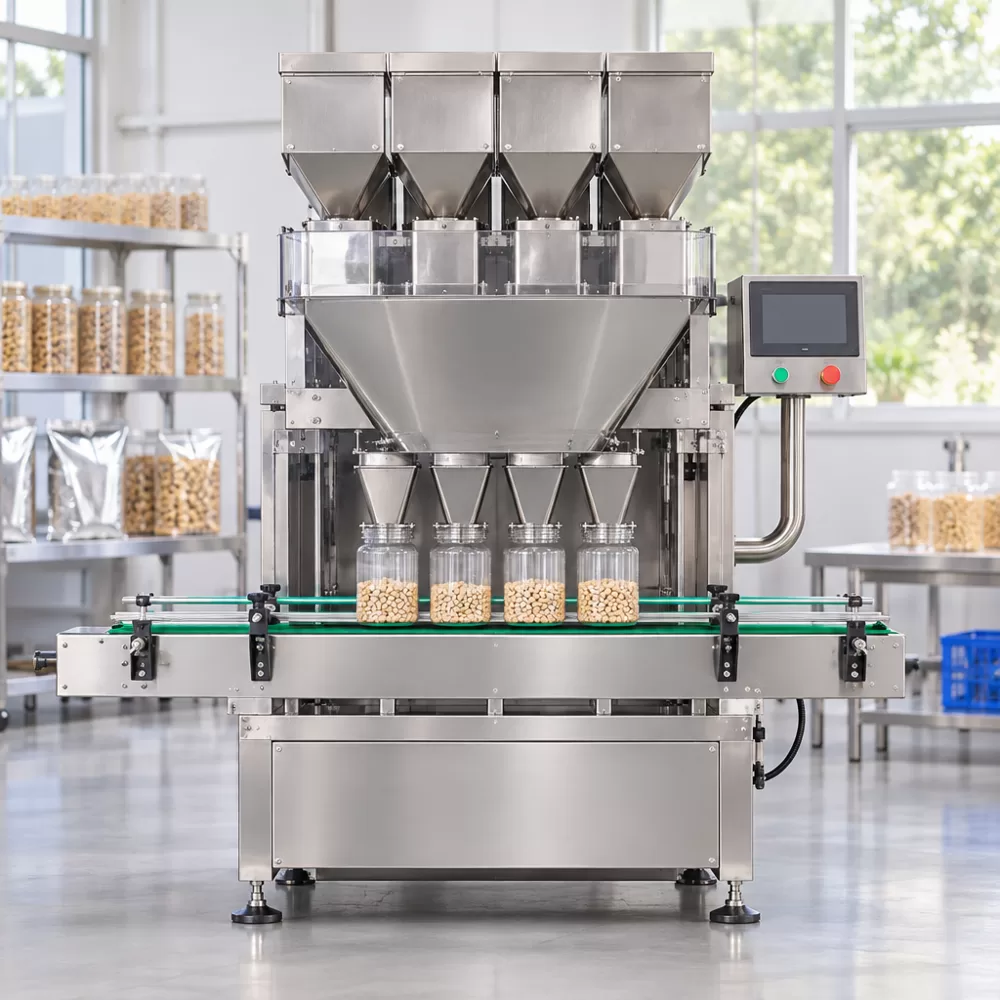
The CB-VD73D integrates direct gravimetric measurement with continuous vertical form-fill-seal packaging for dry bulk materials. Manufactured with a brushed stainless steel structural framework, the unit measures 2 meters in total height. The system accommodates heavy bulk fills ranging from 0.5 kg to 10 kg, featuring twin-vibration linear feeders, digital signal processing sensors, a dosing hopper volume listed at 10 L, and a manufacturer-rated accuracy specification of up to $\le \pm 1.5%$ depending on material properties.
- Packaging Output Speed: 10 to 45 bags per minute, subject to material flow behavior and target fill volume.
- Bag Size Range: Accommodates bag lengths from 20 to 450 mm and bag widths from 140 to 350 mm.
- Packaging Formats: Configurable for pillow, punching, gusseted, and vacuum bag constructions.
- Film Handling Specifications: Accommodates a maximum film width of 730 mm with film thicknesses between 0.06 mm and 0.12 mm.
- Power and Pneumatic Utility Demands: Total connected electrical power of 6.545 kW (380V, 50Hz) and compressed air consumption of 0.8 m³/min at 0.8 MPa.
Drive System Integration: Servo Film Pulling and Sealing
Handling heavy product drops up to 10 kg introduces dynamic pulling forces on packaging material within the vertical forming section. The CB-VD73D incorporates servo-driven film pulling belts paired with servo-actuated horizontal sealing jaws. Servo motor motion profiles provide smooth acceleration and deceleration curves, which helps maintain consistent film tracking and controlled indexing through the forming collar assembly.
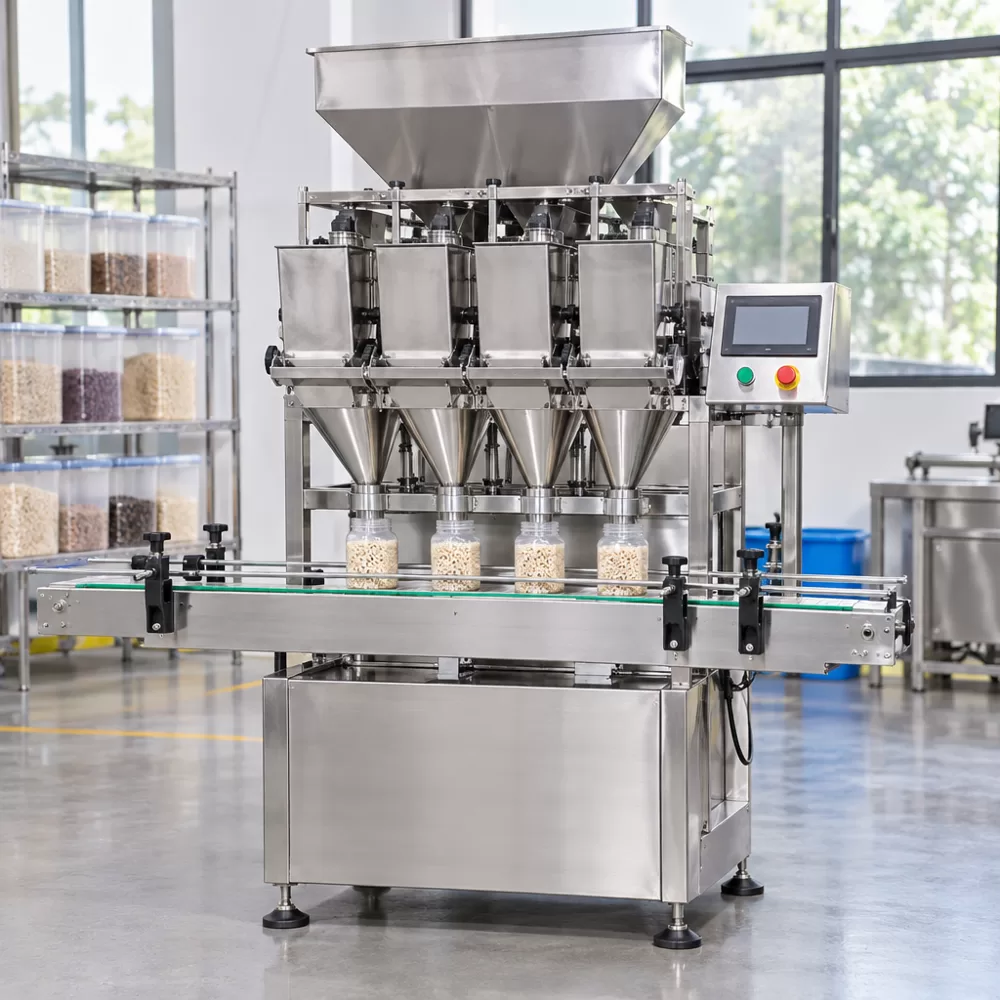
The servo-driven sealing jaws deliver regulated sealing force and repeatable closure dwell times, which assists in establishing hermetic seals across compatible packaging laminates. Forming stable seals across thick film structures between 0.06 mm and 0.12 mm requires balancing jaw pressure, heating element temperature, and dwell time according to the film substrate. This controlled mechanical motion supports consistent pouch formation across pillow, punched, and gusseted packaging formats.
Digital Control System and Automated Protection Functions
The CB-VD73D utilizes an industrial programmable logic controller (PLC) coupled with a large color touchscreen interface, providing accessible parameter configuration for packaging operators. Digital signal processing boards interpret sensor data from the weighing assemblies, interfacing directly with the twin-vibration linear feeders to manage material movement. The twin-vibration linear feeder arrangement enhances material feeding performance, helping to mitigate jamming when handling non-uniform granular products.
Automated protection and warning routines are built into the machine control architecture to minimize product and packaging loss during line stoppages. When the system detects operational deviations, warning alerts notify operators to intervene before material spillage occurs. Integrating bulk feeding, gravimetric measuring, vertical bag forming, date printing, and discharge into a unified system helps operators maintain smooth material flow throughout continuous production shifts.
Practical Steps for Sizing and Implementing a Gravimetric Line
Step 1: Characterize Material Flow Properties
Properly engineering an automated packaging line begins with evaluating the physical and rheological flow characteristics of your dry bulk product. Granular commodities display distinct behaviors depending on particle geometry, surface moisture, aeration, and compaction history under pressure. Before selecting hopper volumes and tray profiles, packaging engineers should analyze material behavior under real plant conditions:
- Measure product bulk density across loose and compacted states to verify that hopper volumes accommodate the necessary mass.
- Assess particle cohesion and angle of repose to identify potential bridging tendencies within feed hoppers and transition funnels.
- Examine material fragility to determine whether vibrating trays require specific drop heights or coatings to minimize product degradation.
Step 2: Establish Realistic Speed and Accuracy Targets
Balancing operational throughput against mandatory weighing precision requires establishing realistic process tolerances based on statutory fill requirements, raw material costs, and downstream processing capabilities. Every packaging line must balance cycle frequency against the mechanical settle time necessary for load sensors to register true mass. Engineers can establish reliable operational benchmarks by working through several practical evaluation points:
- Define target packaging weight thresholds in accordance with statutory net-content requirements and internal quality margins.
- Determine required dribble-feed durations during operational testing to ensure the load cell stabilizes before final mass cutoff.
- Confirm that the selected weighing head configuration delivers adequate combined cycle speeds to support downstream cartoning or palletizing lines.
Step 3: Integrate Infeed and Quality Verification Systems
A gravimetric filling machine operates with the highest consistency when properly synchronized with upstream bulk handling systems and downstream packaging verification equipment. Inconsistent supply levels inside the primary overhead surge bin create pressure variations that alter material flow velocities along the vibratory trays. Line designers can stabilize overall operating conditions by coordinating peripheral material handling and inspection units across the complete packaging cell:
- Connect the top distribution funnel to a dedicated bucket elevator or conveyor to maintain consistent material head pressure.
- Install an inline checkweigher downstream of the vertical packaging unit to continuously verify finished bag weights and detect process shifts.
- Evaluate secondary equipment integration, such as hot-stamp date printers or gas flushing systems, to satisfy batch traceability and shelf-life requirements.
Maintenance Protocols to Preserve Gravimetric Accuracy
Structural Rigidity and Mechanical Isolation Checks
Overhead support platforms holding gravimetric filling machinery must provide rigid structural stability to isolate delicate load cells from plant disturbances. Frame deflections caused by adjacent equipment or vibrating packaging machinery introduce low-frequency mechanical disturbances that interfere with load cell stability. Technicians should inspect structural mounting bolts and isolation dampeners periodically, verifying that all fastenings meet specified torque ratings across the support frame.
Cables and pneumatic feed lines attached to the weighing assemblies must hang freely without exerting mechanical tension on sensitive components. Stiff hoses or tightly bound electrical harnesses can introduce external side forces into load sensors, generating calibration offsets over time. Ensuring adequate clearance around weighing assemblies preserves baseline measurement fidelity under routine operational loads.
Routine Calibration and Reference Weight Checks
Maintaining weighing precision requires establishing a structured verification and calibration routine based on operating intensity, plant conditions, and regulatory obligations. Plant technicians routinely differentiate between automated zero-point compensations, periodic verification tests using certified masses, and comprehensive recalibration procedures. Regular reference checks confirm sensor linearity and ensure that small tare adjustments do not mask underlying mechanical binding or electrical drift across high-volume production cycles:
- Conduct periodic verification checks using certified reference test weights placed directly on the weigh buckets to evaluate measurement linearity.
- Monitor automatic zero-tracking parameters to confirm the controller correctly zeros the empty buckets between filling cycles.
- Inspect mechanical bucket pivots and pneumatic gate linkages for physical wear or contamination that could introduce mechanical binding.
Sanitation Procedures and Surface Care
Food products, seed coatings, and chemical granules can leave residues on vibratory trays and weigh buckets over extended production runs. Product buildup increases surface friction, altering material conveyance speed and impacting fine-feed cutoff precision over consecutive operating hours. Establishing regular cleaning schedules prevents material accumulation and maintains predictable product transfer across all dosing channels throughout demanding multi-shift schedules.
Smooth stainless steel contact surfaces facilitate thorough cleaning and help prevent cross-contamination between product changeovers. However, washdown procedures must strictly adhere to the manufacturer’s specified environmental protection ratings. Where equipment is not rated for high-pressure water washdown, operators should utilize dry brush techniques, vacuuming, or manufacturer-approved sanitizing wipe-down procedures to protect internal electronics.
Frequently Asked Questions (FAQs)
How does a net weight filling machine differ from a gross weight filling system?
A net weight filling machine measures the product mass independently inside a dedicated weigh bucket before dropping it into the container. This mechanical separation prevents container weight variations from impacting the product mass calculation. In gross weight filling, the container is placed directly on the scale and weighed together with the incoming material. While gross weighers can tare individual containers prior to filling, net weight systems allow product weighing to occur concurrently with container indexing. Overall line throughput, however, depends on specific machine configurations, container handling mechanisms, and material settling dynamics.
Can a net weight filler handle fragile or irregular products without excessive breakage?
Linear net weight fillers are well suited for handling friable or fragile materials, including snack foods, seeds, and dried agricultural products. Because products advance along gently vibrating linear trays rather than being forced through high-speed mechanical screws or tight centrifugal passages, mechanical abrasion and particle breakdown remain minimal. Setting appropriate tray vibration amplitudes and minimizing vertical drop heights preserves product integrity.
How does bulk density variation impact gravimetric dosing accuracy?
While a gravimetric filler targets a fixed mass rather than a fixed volume, significant density changes alter the material’s flow dynamics across the vibratory feeder trays. Variations in bulk density affect how material discharges during the fine-feed phase and can alter the weight of material suspended in-flight at the moment of gate closure. Consequently, while direct weighing eliminates gross volumetric calculation errors, operators must calibrate in-flight compensation parameters and verify finished package weights via downstream inspection whenever processing material with shifting density profiles.
What maintenance routines prevent load cell calibration drift?
Preventing calibration drift involves keeping weigh buckets clean of product accumulation, checking mechanical gate linkages for mechanical binding, and performing routine verification tests with certified test weights. Ensuring that structural vibration isolation mounts remain intact protects sensitive load cells from high-energy mechanical shocks, while proper cable routing avoids external side-loading on the sensors.
How are filling cycles synchronized between linear weighers and vertical bagging units?
Synchronization between linear weighers and vertical form-fill-seal machines is coordinated via programmable logic controllers. In a typical packaging cycle, the vertical bagging unit pulls film, forms the tube, and seals the bottom and sides of the pouch. Once the bag structure is in place to receive material, the controller signals the appropriate weigh bucket to open its discharge gate, ensuring product drops cleanly into the formed container before the top seal is completed.
Maximizing Packaging Line Yield with Targeted Gravimetric Automation
Implementing an automated net weight filling machine allows manufacturing operations to reduce costly product giveaway while complying with statutory net-content packaging requirements. By measuring bulk goods according to true mass rather than volumetric estimates, processing plants maintain consistent dosing accuracy across fluctuating bulk densities and multi-shift schedules. Whether packaging agricultural seeds, industrial powders, grains, or snack foods, selecting appropriate gravimetric equipment supported by proper calibration, material characterization, and downstream inspection helps maintain packaging quality and protects long-term operational profitability.


-
VFFS Equipment: The Ultimate Guide to Vertical Form Fill Seal Technology
13-03-2026 -
The Essential Guide to Weight Packing Machines for Precision Weighing
12-03-2026 -
Power Packing Machine: The Ultimate Guide to Heavy-Duty Packaging Efficiency
11-03-2026 -
Weigher Packing Machine: The Definitive Guide to Precision Weighing & Packaging
10-03-2026 -
Auger Type Powder Filling Machine: The Ultimate Guide to Precision Packaging
09-03-2026 -
Advanced Packing Solutions: Snacks, Sugar, and Frozen Food Machines
29-10-2025 -
Efficient and Reliable Solutions for Salt, Nuts, and Frozen Dumplings Packing
29-10-2025 -
High-Performance Biscuits, Lollipop, and Ketchup Packing Machines for Modern Food Production
29-10-2025 -
Efficient Liquid Filling and Packing Machines for Modern Production
23-10-2025 -
Reliable Granule Packaging Machines for Efficient Production
23-10-2025
